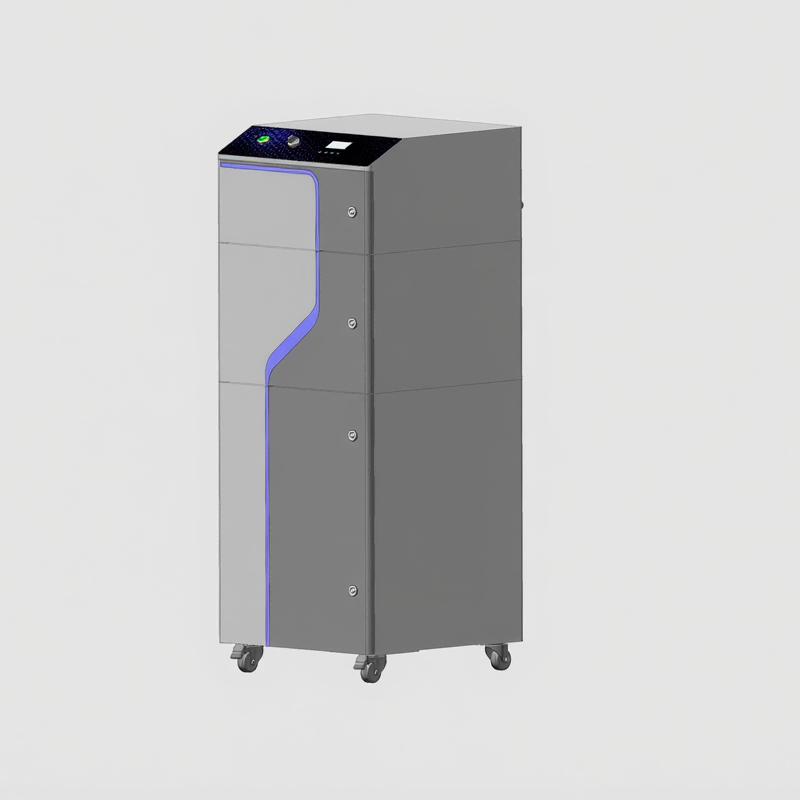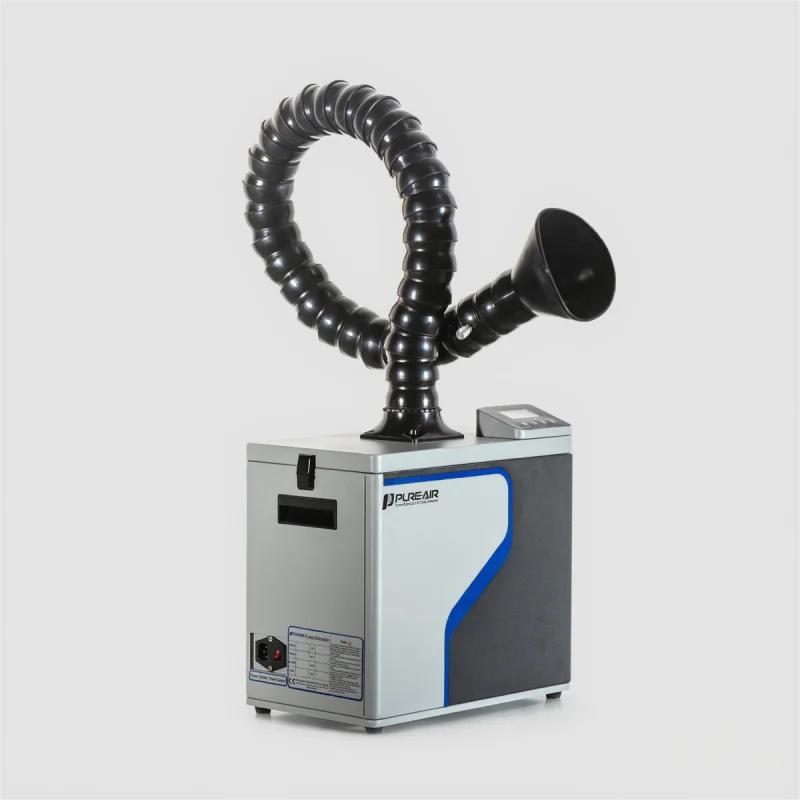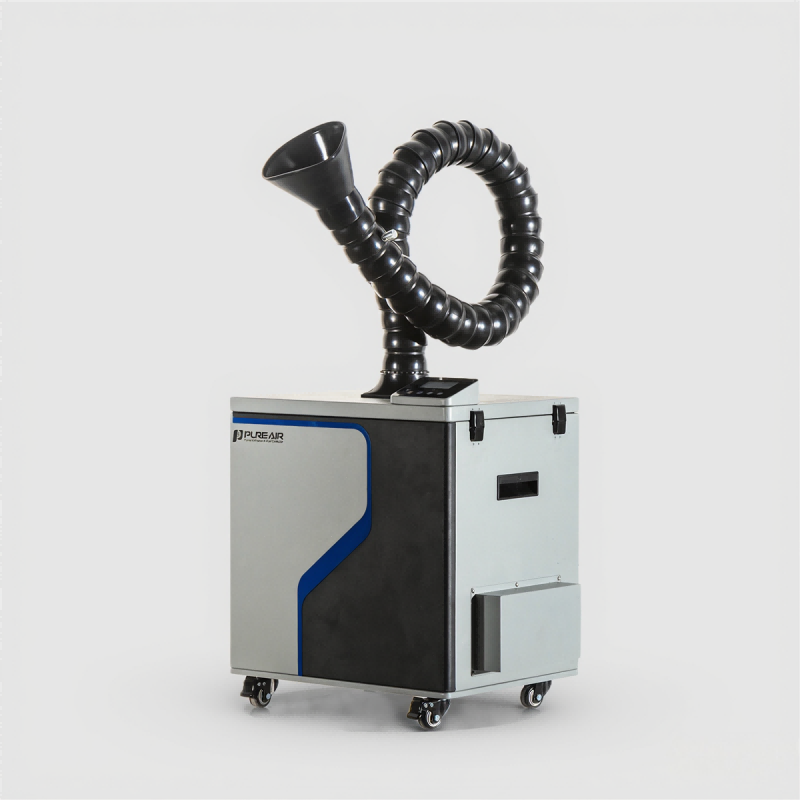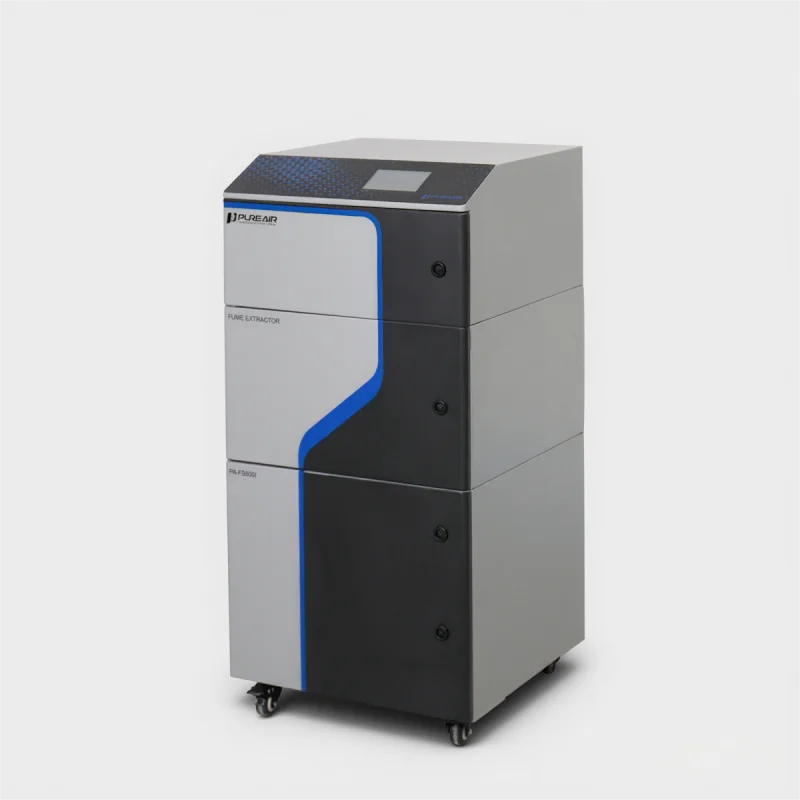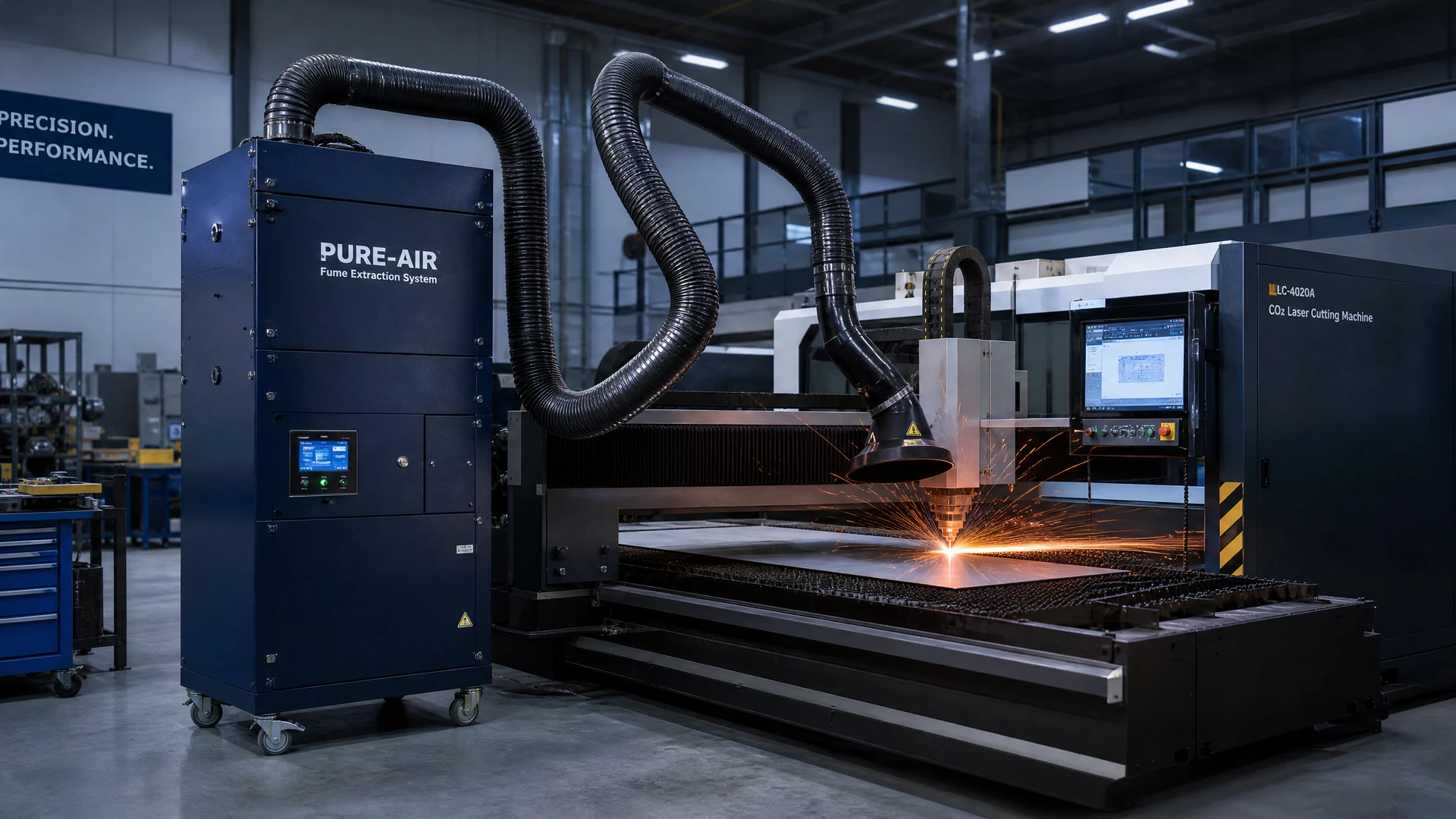
1. Static pressure beats airflow
Every extractor advertises airflow (m³/h or CFM), but airflow is measured with clean filters and no duct. What keeps smoke moving through a loaded HEPA stack and two meters of hose is negative pressure, measured in Pascals (Pa). A unit rated 300 m³/h at 3,700 Pa will outperform a '500 CFM' booth fan pushing against 200 Pa the moment the filters start loading.
Rule of thumb: for enclosed desktop lasers, look for at least 2,500 Pa. For daily production cutting, 8,000-10,000 Pa platforms maintain capture velocity for months between filter changes. This is why PURE-AIR's FS-series runs 8,000-10,000 Pa where typical hobby extractors run 1,000-2,000.
2. HEPA class: H13 is the floor, H14 is better
True HEPA filters carry an EN 1822 class: H13 captures 99.97% of particles at the most-penetrating 0.3µm size; H14 captures 99.99%. 'HEPA-like' or 'HEPA-type' filters carry no rating at all and can pass 5-10% of ultrafine particulate. Laser fume skews ultrafine, so the class difference is not academic.
Also check the filter architecture: deep-pleat designs pack more media area (12-30 m² in PURE-AIR's F9 pre-stages) which translates directly to filter life.
3. Carbon is measured in kilograms, not promises
Activated carbon removes VOCs and odor by adsorption — a finite capacity that scales with carbon mass. A thin carbon-impregnated pad (50-200 g) saturates within days of acrylic cutting. A treated carbon bed of 12-30 kg lasts months doing the same work. If a manufacturer won't tell you the carbon weight, assume it's a pad.
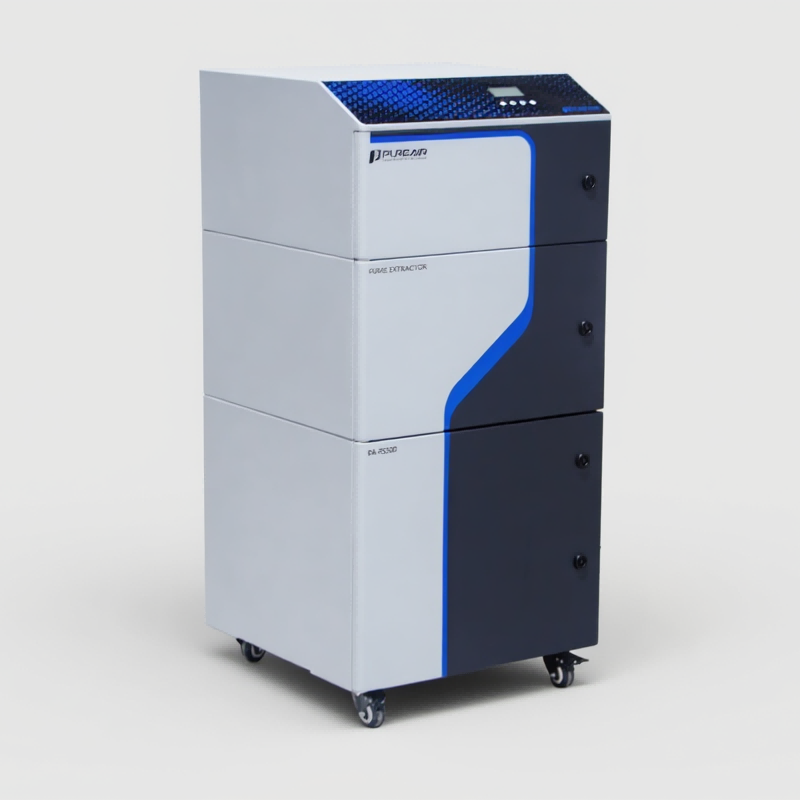
4. Noise decides whether you'll actually use it
An extractor you switch off is worthless. Desktop workspaces want under 60 dBA at working speed — roughly conversation volume. Brushless motors help here twice: quieter operation and 30,000-hour maintenance-free life.
5. Filter economics: the real price is the annual cost
Sealed all-in-one cartridges force you to discard clean carbon because the HEPA clogged first (or vice versa). Modular stacks let you replace only the spent stage — that's a 40-50% running-cost reduction, which over three years usually exceeds the purchase-price difference between extractors.
| Setup | Annual filter cost | Why |
|---|---|---|
| PURE-AIR modular set | ~$158/yr | 2 sets/yr @ $79, replace per stage |
| Typical OEM sealed cartridge | ~$360/yr | 6 packs/yr @ $60, all-or-nothing |
| Glowforge OEM filter | ~$750/yr | 3 units/yr @ $250, clogs fast on MDF |
Match it to your machine
Specs only matter in context — a 20W diode marker and a 100W CO2 cutter need very different platforms. Our Fit Guide maps every popular xTool, Bambu Lab, Glowforge, Creality Falcon, OMTech and Thunder machine to the right PURE-AIR extractor, port size and adapter in one table.