
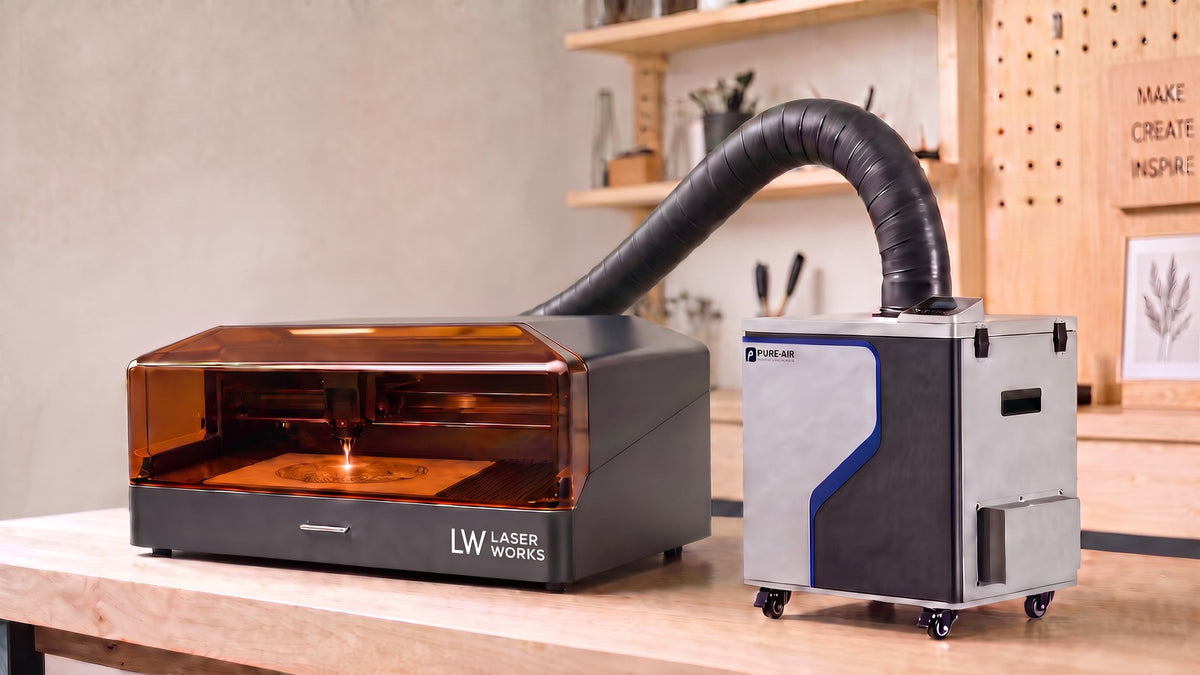
The short answer: yes — and 'it smells fine' means nothing
Laser cutting and engraving work by vaporizing material with concentrated heat. That vapor doesn't disappear — it condenses into ultrafine particulate (much of it smaller than 0.3 microns, small enough to reach deep lung tissue) and a mix of volatile organic compounds (VOCs) that varies by material. Some of the most harmful emissions, like carbon monoxide and certain aldehydes, are nearly odorless. Conversely, some strong smells are relatively benign. Your nose is not a safety instrument.
Regulators treat these emissions seriously. OSHA sets permissible exposure limits for many of the compounds found in laser fume, and NIOSH classifies ultrafine particulate as a respiratory hazard. For home studios, there is no inspector — which means the filtration decision is entirely yours.
What's in the smoke, material by material
Different materials release very different hazards when vaporized. The table below summarizes the most common maker materials and their primary emission risks.
| Material | Primary emissions | Risk level |
|---|---|---|
| Acrylic (PMMA) | Methyl methacrylate (MMA) monomer | Moderate — strong irritant, flammable vapor |
| MDF / plywood | Formaldehyde, fine wood dust | High — formaldehyde is a known carcinogen |
| Leather (real) | Sulfur compounds, chrome traces (tanned) | High — chrome-tanned leather releases toxic compounds |
| PVC / vinyl | Hydrogen chloride, dioxins | NEVER CUT — corrosive gas destroys lungs and machine |
| ABS | Styrene, hydrogen cyanide traces | High — avoid or ventilate aggressively |
| Hardwoods | Fine dust, natural resins | Moderate — sensitizer for some users |
| Paper / cardboard | Fine particulate | Lower — but volume adds up fast |
Ventilation vs. filtration: which do you need?

Venting out a window works — if you have a window, if your neighbors tolerate the exhaust, and if your climate cooperates. For everyone else, a recirculating fume extractor with true HEPA and activated carbon is the standard answer. The key specs to check: HEPA class (H13 captures 99.97% at 0.3µm; H14 captures 99.99%), carbon bed weight (odor removal is a function of carbon mass — look for kilograms, not grams), and negative pressure (higher Pa ratings keep suction strong as filters load).
PURE-AIR desktop extractors pair H14 deep-pleat HEPA with 12-30 kg treated activated-carbon beds — an order of magnitude more carbon than the pad-style filters bundled with many hobby lasers. That difference is exactly why bundled filters 'work' for a week and then the smell comes back.
The bottom line
You don't need to fear your laser — you need to respect the fume. Never cut PVC or chlorinated plastics, prefer H14-grade filtration with a real carbon bed for indoor use, and change filter stages on schedule. If you're running an enclosed diode or CO2 laser indoors, browse our compatibility guide to match an extractor to your exact machine in under a minute.